
Does Your Bathroom Vanity Need a Backsplash?
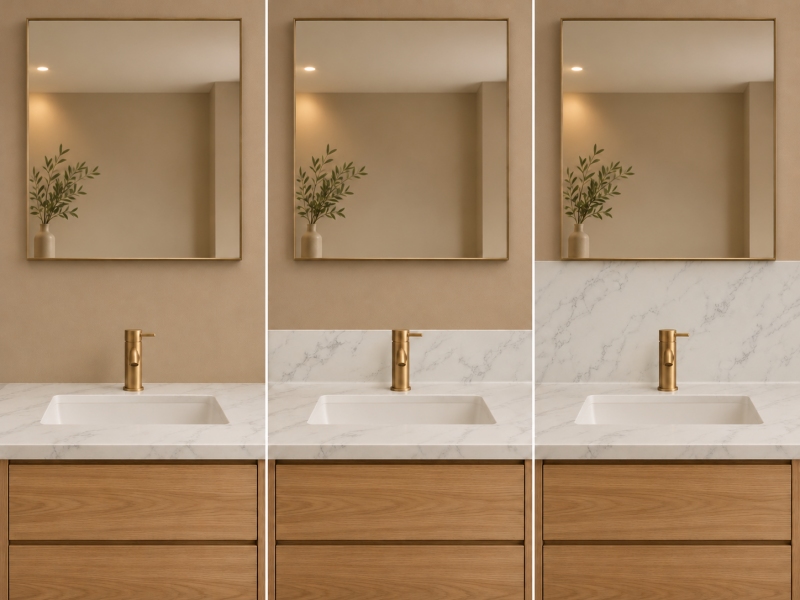
After choosing a solid surface vanity top, there’s one detail worth settling before the drawings are finalized. How should the top meet the wall? A short backsplash can protect the area directly behind the basin, a full-height panel can cover the wall up to the mirror, and a suitable tiled wall can sometimes serve as the backsplash on its own.
The right choice depends on how often the vanity gets wet, how the wall is finished, and how the area will be cleaned.
Why Choose a Coved Backsplash for a Solid Surface Vanity?
A coved backsplash has a smooth radius where the vanity top turns up toward the wall. Around the basin, that rounded transition makes it easier to wipe away splashed water, soap, and toothpaste in one pass.
When the cove is fabricated as a bonded solid surface joint, the visible transition can be finished without an exposed silicone bead at the inside corner. The junction where the backsplash meets the wall still needs to be detailed for the installation. For hotel vanities and long multi-basin counters in public washrooms, the cove gives cleaning staff a smooth transition to wipe along the back of the top.
Short, Full-Height, or No Separate Backsplash?
| Option | When it makes sense |
|---|---|
| Short coved backsplash | A 100 mm upstand is one option when the main splash zone is just behind the basin, or when tile already protects the wall above. The height can be adjusted to suit the faucet, mirror, and wall finish. |
| Full-height backsplash | Extend the same solid surface from the vanity top to the underside of the mirror or mirror cabinet when you want to cover an untiled wall and create a coordinated finish. When the panel meets the mirror or cabinet, there is no exposed top ledge to collect dust. Allow for the extra material and any cutouts for wall-mounted fixtures. |
| No separate backsplash | This can work in a low-splash powder room, or where tile or another suitable wall finish runs directly down to the vanity top. Plan the countertop-to-wall joint so it can be sealed and cleaned. |
Start with the Basin and the Wall Finish
If the vanity is already backed by tile, a short coved upstand can still be useful. The tile protects the wall above, while the cove makes the base of the wall easier to wipe. If the wall is untiled and frequently exposed to splashes, consider a matching panel that extends to the mirror.
For a hotel or public washroom, review the detail across the entire vanity run. Basin spacing, faucet positions, side walls, and joints between sections all affect how the backsplash fits. Confirming these details early helps you compare the cost of a short cove and a full-height panel before fabrication.
Custom Solid Surface Vanity Tops from GELO
GELO can review preliminary drawings and prepare an initial budget based on the vanity dimensions, basin layout, backsplash height, and cove detail. For overseas projects, we can also support shop drawing approval, sampling, batch fabrication, factory trial assembly, protective packaging, and shipping coordination.
Planning a bathroom vanity project?
Send GELO your vanity dimensions, basin and faucet layout, wall finish, and quantities. We can help you select a backsplash detail and prepare a preliminary estimate.


